Industry Trends
CarGurus study reveals consumers' perceptions of EVs vs reality
[This article is a summarized version of detailed survey findings, which can be found here.]
Electric vehicles (EVs) have recently garnered attention due to slowed sales growth, revised automaker expectations, and ongoing concerns about their viability compared to internal combustion engine (ICE) vehicles. To understand this shift and gauge consumer sentiment, CarGurus surveyed 1,050 car shoppers in March and April 2024. The survey aimed to bridge the gap between consumer perception and reality, helping you promote wider EV adoption by addressing key barriers. Read the full findings here and see a summary of key takeaways below.
Perception 1: EVs don’t have enough range
When respondents were asked to estimate the median driving range for a 2023 model year EV:
- 58% underestimated the median range of EVs, saying it was 250 miles or less
- 27% got it right (estimating 251-300 miles)
- 15% overestimated the median range, saying it was more than 300 miles
What’s more, when respondents were asked to select all of the reasons they might be hesitant to consider an EV, “range” and “access to a charging network” topped the list, with 60% of respondents selecting each.
Reality: EV range aligns with typical driving habits
According to the Department of Energy, the median range for EVs in 2023 was 270 miles and Federal data from 2022 also shows that people drive 13,476 miles a year, on average, or 259 miles per week. According to the survey, 80% of respondents said they drive 250 miles or less each week.
What this means for you…
Since a majority of car shoppers underestimate EV range, it creates an opportunity for you to boost EV adoption by educating your shoppers about the actual median range of EVs and how it aligns with typical driving habits. Highlighting this information can address misconceptions and alleviate concerns about range and charging infrastructure.
Perception 2: EVs are too expensive
A recurring issue for consumers regarding EVs is their perceived cost, which consistently appears in surveys and consumer studies. In the latest survey, "cost to purchase" was the third most common concern, cited by 53% of respondents, following "range" and "access to charging." Many consumers remain unaware of incentives that can help reduce the cost of EVs. Specifically, 41% of respondents were unaware of any federal or state benefits or incentives for EVs. Among those who were aware, only 28% knew these incentives could apply to used EVs, compared to 44% who knew they could apply to new EVs.
Reality: Prices have been declining for a while now
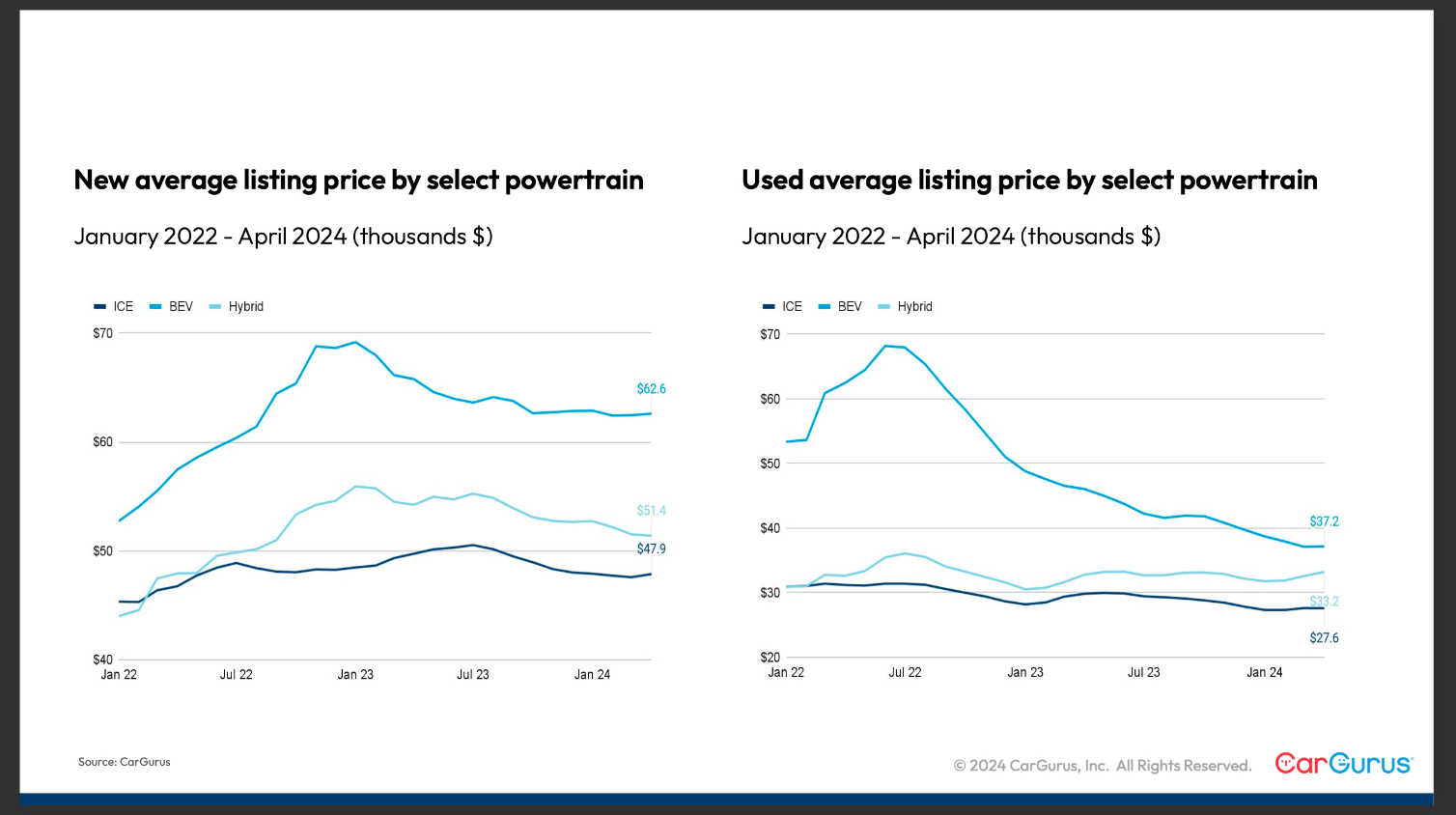
EVs are becoming more affordable, with the average listing price of new EVs dropping 5% YoY in April, marking the eighth consecutive month of decline. Used EV prices have also fallen significantly, decreasing 19% YoY for the 17th consecutive month. The price gap between used gas vehicles and fully electric vehicles has shrunk by 74% since June 2022. Among the top ten used vehicles with the largest price drops in April 2024, all but one were EVs, with prices falling between 30% and 38% YoY. Additionally, the availability of used EVs has increased, and many are now eligible for the used EV tax credit, with 36% of all EV listings priced under $25,000 (up from 18% the previous year). As prices have decreased, interest in used EVs has surged, with views on CarGurus up 36% YoY in the first quarter of 2024.
What this means for you…
Address your shoppers’ concerns about cost by increasing awareness and education about federal and state incentives for both new and used EVs. Highlight the decreasing prices of EVs, with significant YoY drops, and the growing availability of used EVs under $25,000 that qualify for tax credits. Also some EVs are eligible for lease incentives, which might be appealing to shoppers who enter the market knowing they want to lease. Emphasizing these tax credits and incentives can help mitigate cost perceptions and attract more buyers to the EV market.
Perception 3: Opinions on EVs are based on experience
Up until now, EVs’ growth has been fueled by early adopters who were willing to overlook the inherent challenges that came with such a seismic shift in energy type, plus drivers in coastal states where charging infrastructure was more mature. More recently, steep price cuts by brands like Tesla, Ford, Hyundai, and Audi, have also spurred interest from buyers on the fence about the switch away from ICE. Now that EV demand is cooling – and automakers are hurriedly adjusting their expectations and investments accordingly – the assumption is often that shoppers have experienced EVs and are dismissing them for aforementioned reasons (range, price, and access to charging).
Reality: Many consumers have limited, if any, experience with EVs.
The majority of respondents (60%) reported that they hadn't ridden in or driven any type of EV - such as a full battery electric, plug-in hybrid, or hybrid - in the past six months. Additionally, almost half (47%) said they didn't know any friends, family, co-workers, or neighbors who owned an EV.
What this means for you…
More exposure to EVs could help drive growth. As with any new technology, consumers are understandably wary of EVs as a whole. People’s key concerns about EVs haven’t evolved much since these vehicles first hit the road years ago, but the technology has and will continue to evolve significantly. The next wave of EV growth will have a lot to do with exposure and education. Don’t underestimate the importance of promoting more test drives and demos for EVs or PHEVs. As these vehicles gain increasing share in the market, it’s essential to show shoppers how EVs can fit into their lifestyle.