Industry Trends
CarGurus Intelligence Report - Q3 2026

The affordability squeeze is becoming a powertrain story
For many shoppers, the question is no longer just what they can afford to buy. It’s what they can afford to drive.
Regular gas reached $4.48 per gallon in late September, the highest national average ever recorded for this time of year, according to AAA. The Federal Reserve also raised its benchmark rate by a quarter point on Sept. 16, its first increase since 2023. After holding relatively steady for most of 2026, auto loan rates have started to creep up in recent weeks, following the rise in Treasury yields and the Fed's move. Together, higher fuel and borrowing costs are making the cost of car ownership a more important part of the buying decision.
Our data shows how shoppers are responding in real time: hybrid and EV share of listing views climbed again in Q3 as gas prices rose.
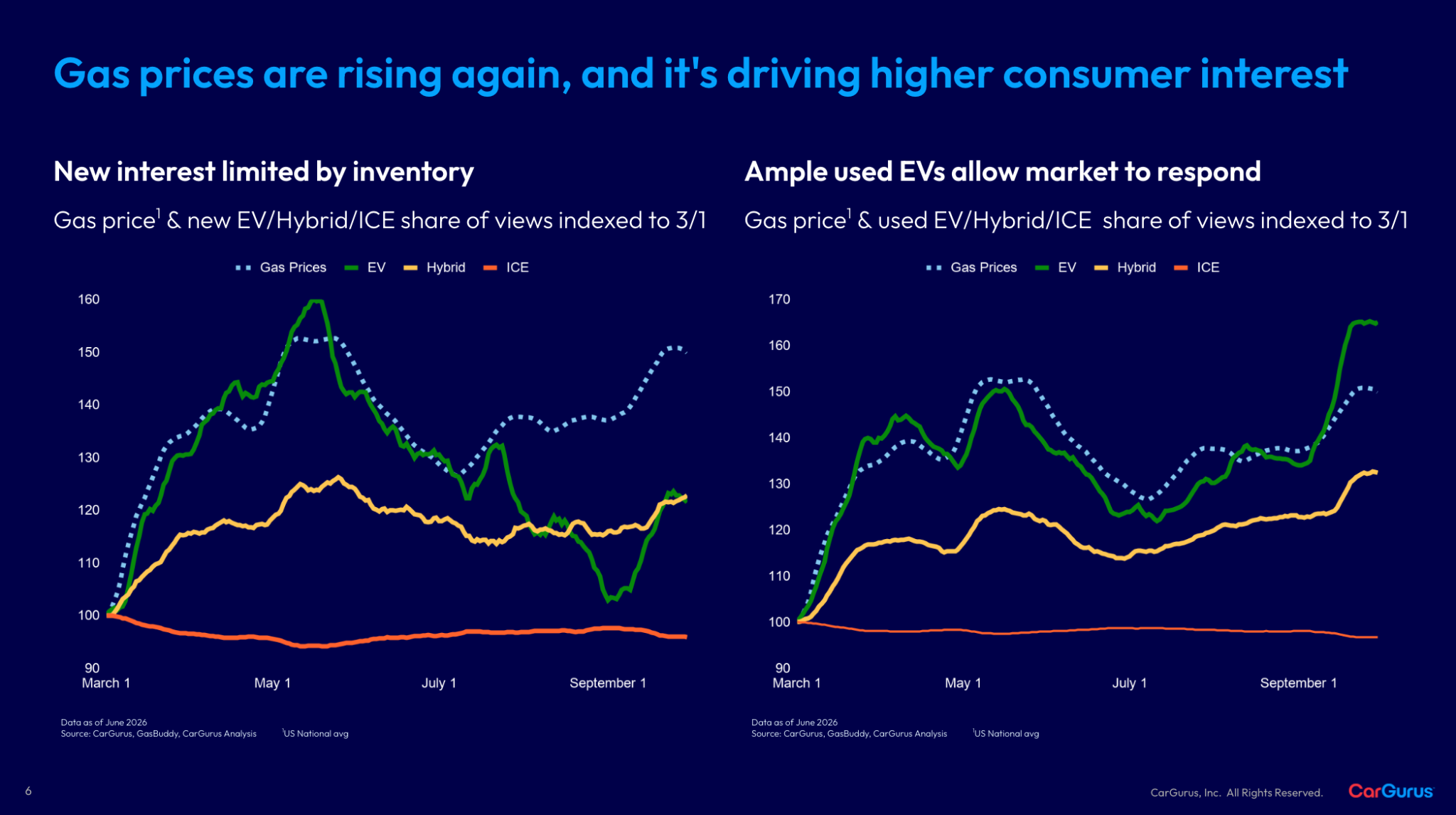
The response to affordability is reshaping the market in three different ways. Hybrid demand is outrunning new supply. New and used EVs are moving in opposite directions. And V8 inventory is growing even as sales aren’t yet keeping pace.
These trends are visible in sell-through rates. Vehicles under $30,000 have the highest sell-through rate in the new market. Higher-priced vehicles also sell through at a strong rate, even with more supply available. The middle of the market is where demand lags.
The K-shaped market has only continued in 2026. At one end, vehicles under $30,000 have the tightest supply and highest sell-through, so shoppers who can find them are buying quickly. At the high end, buyers continue to transact at strong rates despite more supply, while the middle is squeezed from both sides. It lacks the scarcity-driven urgency of the affordable market and the purchasing power supporting the high end. The result is a market where demand is strongest at the edges and affordability pressure is most visible in the middle.
That split helps explain why powertrain choice has become an affordability decision: shoppers aren’t navigating one market, but different versions of it depending on what they can spend.
New hybrid demand is outrunning supply, and buyers are paying for it
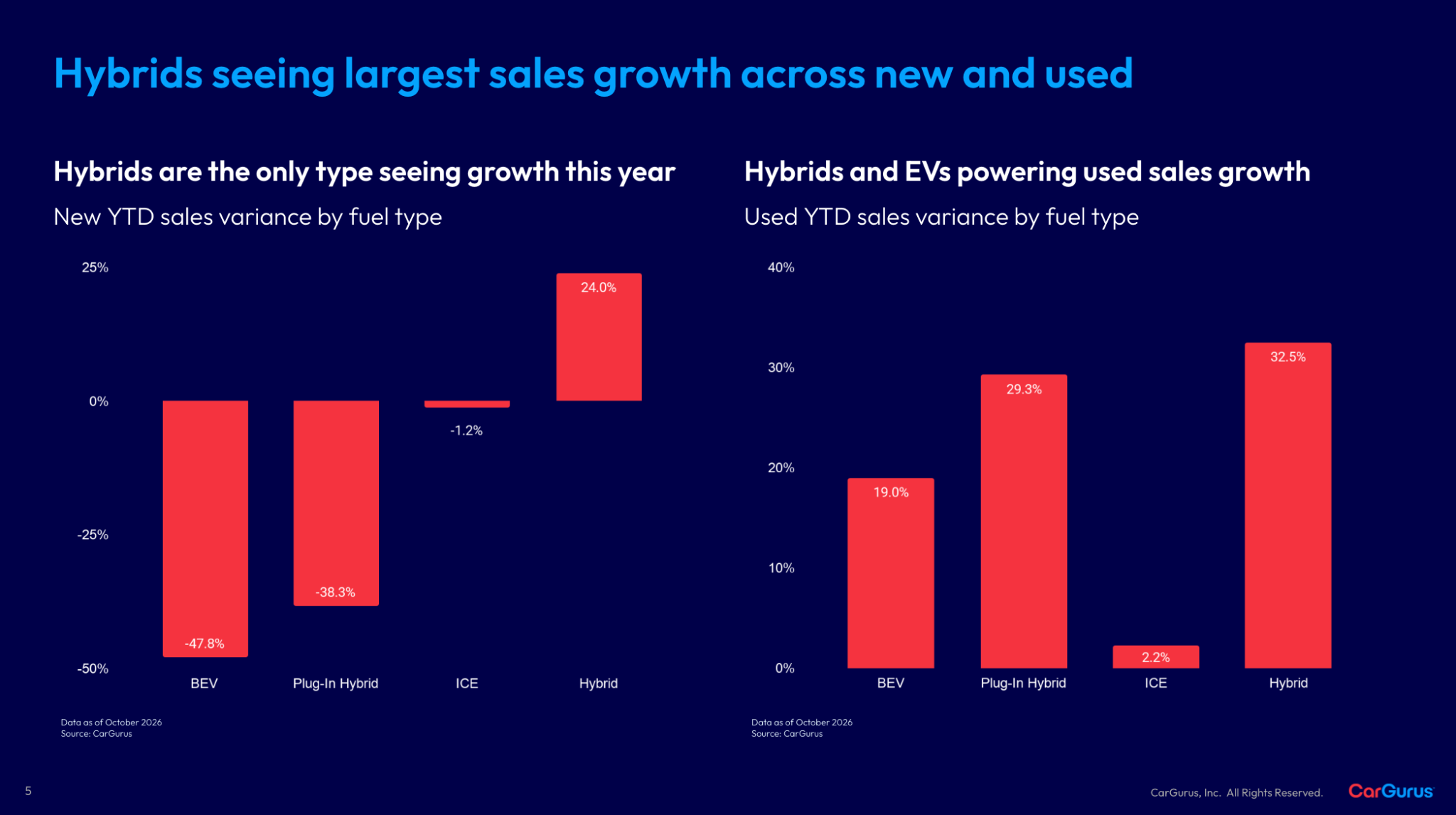
Hybrids are the only mainstream powertrain seeing new vehicle sales growth in 2026. New hybrid sales are up 24% year to date, while gas and EVs are down. Used hybrid sales are also up to nearly 33%.
The shift is more than shoppers wanting better fuel efficiency. The top-selling new hybrids also sit in a relatively accessible range: the Ford Maverick averages $34,200, the Toyota Camry $35,900, the Honda CR-V Hybrid $40,800, and the Toyota RAV4 $41,300. Toyota accounts for 47.2% of new hybrid sales and holds four of the top five spots among the top-selling new hybrids. Its most popular models barely touch the lot: the RAV4 turns in 15.6 days, the Grand Highlander Hybrid in 16.0 days, the Sienna in 17.3 days, and the Camry in 21.7 days.
On several new models, hybrids now outsell their gas counterparts, including the Toyota Highlander, where hybrids account for 65.7% of sales, the Toyota Grand Highlander at 61.5%, and the Ford Maverick at 59.9%. Several of the leading new hybrids also land in the $35,000 to $42,000 range, giving shoppers a way to respond to fuel costs without automatically paying a significant premium.
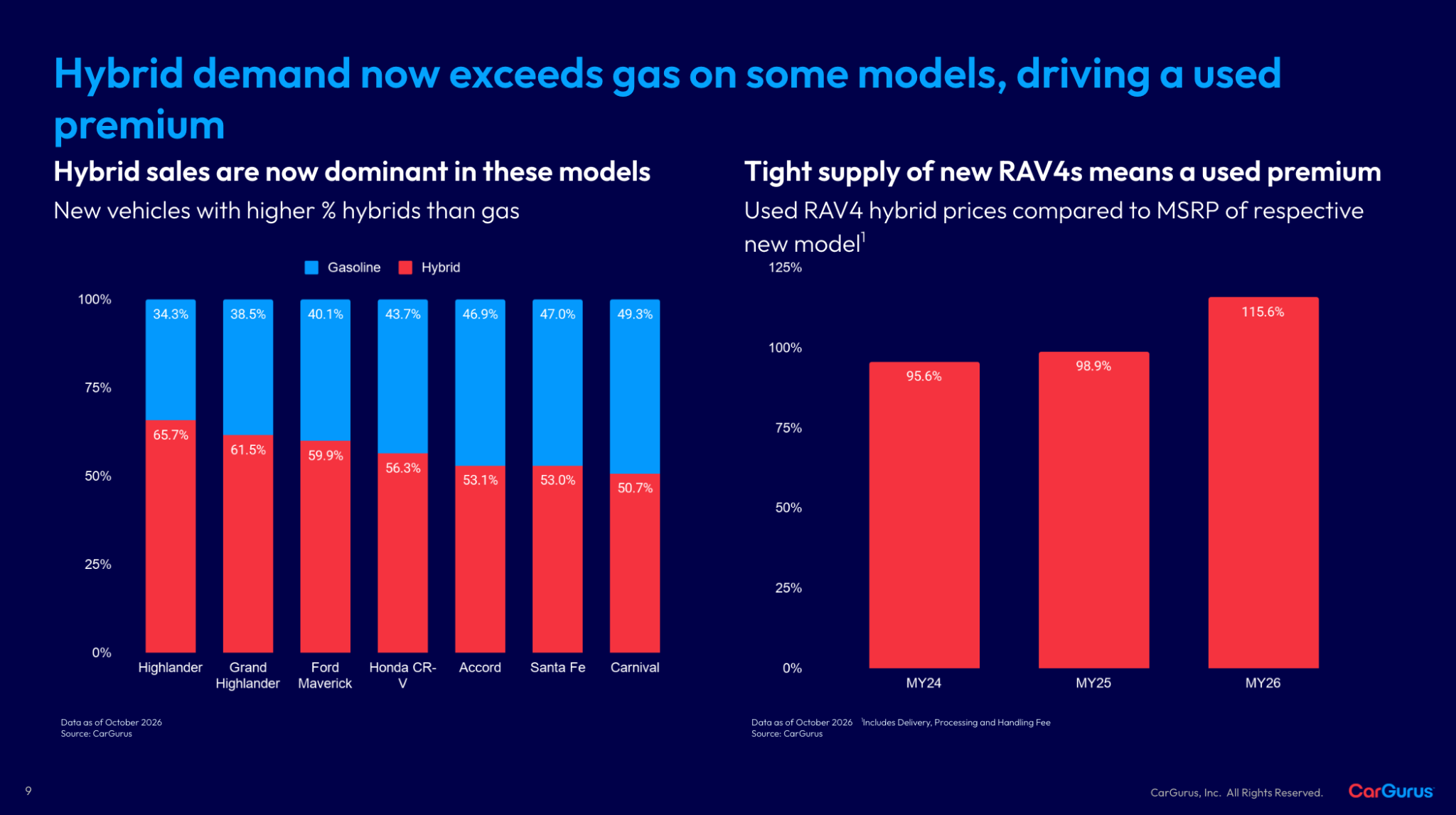
Premiums aren’t entirely escapable, though. Tight Toyota hybrid supply is flipping typical pricing patterns. Used 2026 RAV4 Hybrid listings are averaging 116% of the new 2026 MSRP, or roughly 16% above the new price. Older model years don’t provide much more pricing relief.
That premium is a clear signal of how difficult it is to find a new hybrid in the right configuration. Buyers are not only paying for the vehicle. They’re paying for immediate availability and lower fuel use.
The EV market is splitting in two
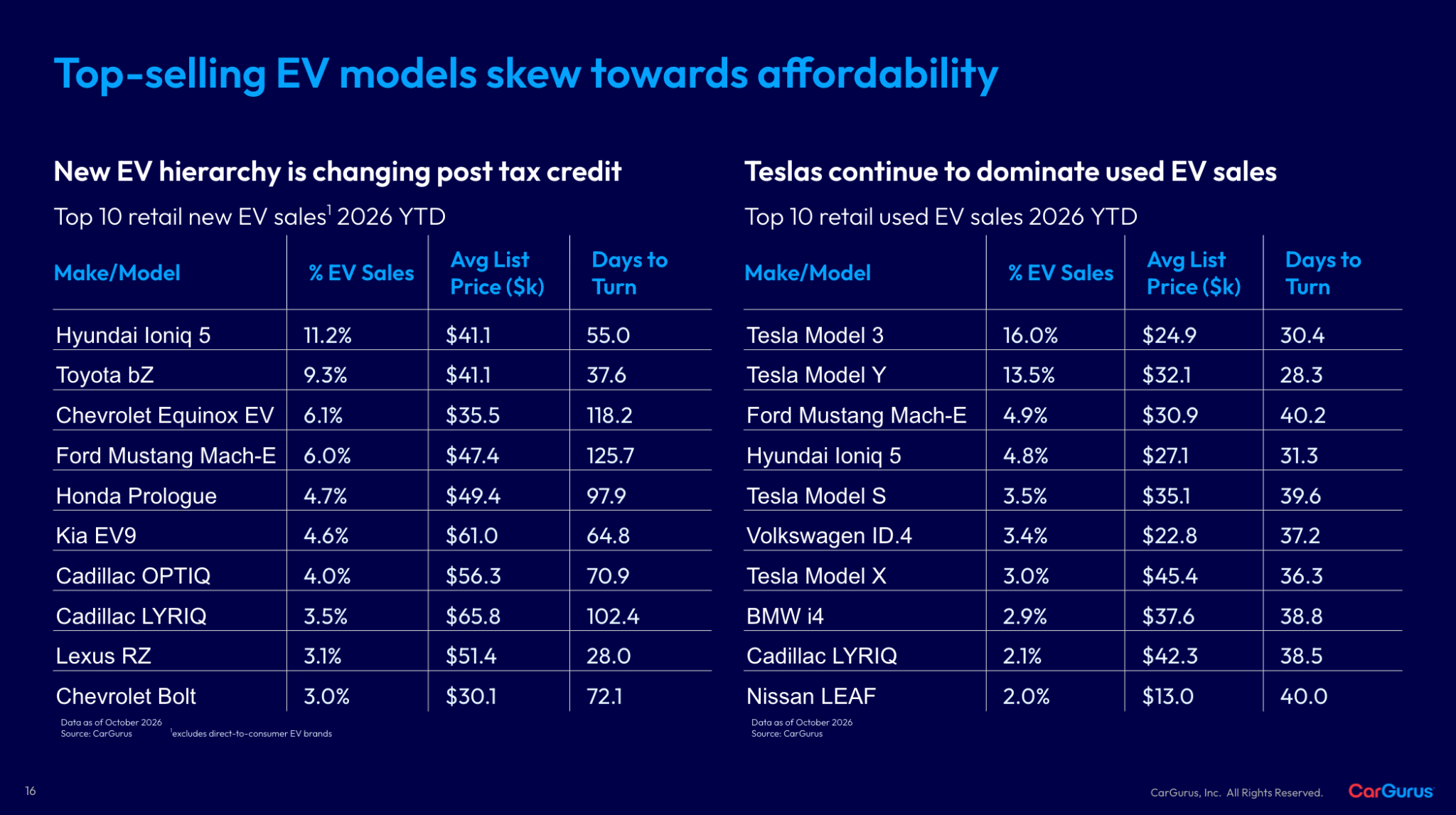
One year after the federal tax credits expired, new and used EVs are moving in opposite directions. New EV sales are down 48% year to date, excluding direct-to-consumer EV brands, while used EV sales are up 19%.
Automakers have responded by pulling new EV inventory back as demand has weakened. New EV inventory was down 34% year over year in September, and the average new EV list price was down 15%. New EV market days supply has increased 82% from its post-tax-credit bottom, suggesting the new market has more inventory to work through even after the pullback. The model-level data shows why: the Toyota bZ turns in 37.6 days and the Hyundai Ioniq 5 in 55.0 days, while the Chevrolet Equinox EV takes 118.2 days despite averaging $35,500.
The used side is moving the other way. Used EV inventory was up 60% year over year in September as off-lease vehicles returned to market. Days supply was up 36% from its post-tax-credit bottom, but average used EV prices are down just 5%. That combination suggests the used market is absorbing the additional supply more steadily than the new market.
The used EV market is where affordability and demand line up. Shoppers are gravitating toward models priced below $32,000: the Model 3 averages $24,900 and turns in 30.4 days, while the Model Y averages $32,100 and turns in 28.3 days.
A year after the expiration of the tax credit shows that EVs can largely perform well when price matches consumer demand.
V8s are back, but the market is not yet keeping up
The affordability pressure pushing shoppers toward hybrids and used EVs isn’t affecting every corner of the market. V8s are returning as buyers (and automakers) for those vehicles are making a different calculation.
Automakers are bringing these engines back as Washington loosens greenhouse gas emissions requirements and has updated CAFE standards. NHTSA’s new SAFE Vehicles Rule III projects a combined industry fleet average of roughly 34.9 mpg in 2031 and removes EVs and compliance credits from the standard-setting analysis.
Automaker product decisions reflect the increased flexibility. Ram pulled the HEMI from the 2025 Ram 1500 and brought it back for 2026, citing customer demand. GM is investing $888 million in new sixth-generation V8s for the 2027 Silverado and Sierra, while Ford has kept the V8 in the F-150 and Mustang.
V8-powered vehicles make up 14.5% of new listings, up 19% year over year, although that share remains below recent years. The rebound is concentrated in full-size pickups, which account for most of the inventory growth. The Dodge Durango is a notable exception outside the truck segment. As the only mid-size CUV still offering a V8, it is drawing rising demand and inventory despite its aging design.
V8s also sit at the opposite end of the affordability spectrum. Their average list price is $75,000, roughly twice the $35,000 to $42,000 range where many leading hybrids land. The average price of an eight-cylinder vehicle is up 26% since 2021, faster than other powertrains.
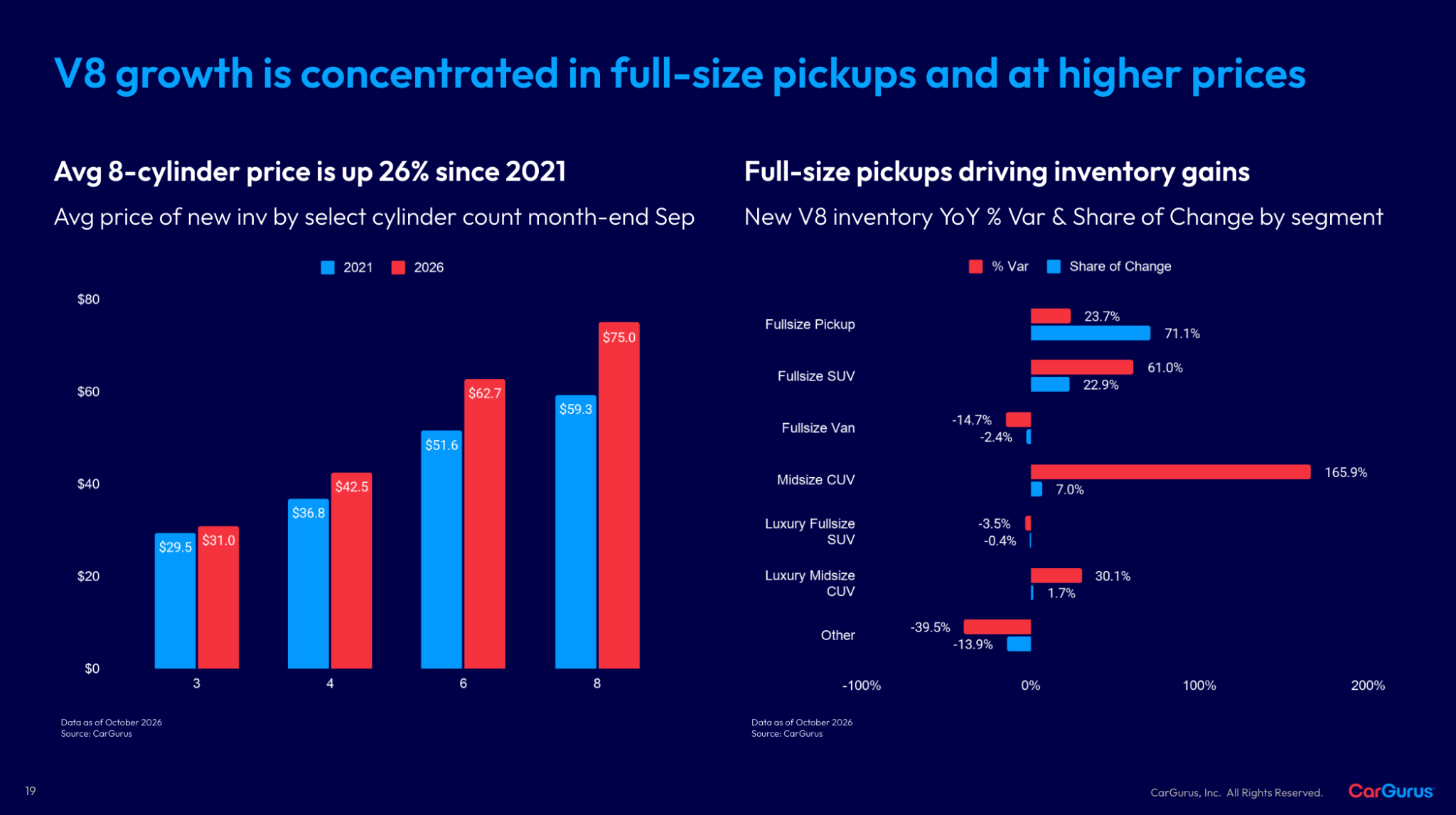
While many shoppers are looking for a lower cost to own, V8 buyers are still choosing performance, size, or capability at a significant premium. And automakers seem to be comfortable making that trade-off for a higher-margin product, even if sales velocity is slower.
For now, demand isn’t keeping pace with the buildup in inventory. V8 sales share is flat while inventory is rising, pushing market days supply higher. The top-selling V8s are almost all full-size pickups: a Chevrolet Silverado 1500 takes 60.0 days to turn, a GMC Sierra 1500 takes 67.2 days, and a Ford F-150 takes 54.4 days. V8 vehicles average 87.7 days on the market.
Higher gas prices could be a culprit here. With the cost of diesel at record highs and gas prices soaring above September norms, shoppers could be reconsidering high-consumption models.
The K-shaped economy is pulling the car market in even more directions
There is no single consumer response to higher ownership costs. Some are paying more for the fuel economy and reliability they want. Others are finding value in used EVs as more inventory comes to market. Still others are buying high-priced V8s despite higher fuel costs.
The common thread is that shoppers are making more deliberate trade-offs between the cost to buy and the cost to own. With another Fed rate decision still ahead this year, that calculation is likely to remain in focus. Any changes in borrowing costs will shape how much monthly payment shoppers can absorb, but the larger story is already clear: powertrain choice is no longer just a question of preference; it has become part of the affordability equation.